What it is
Large language models (LLMs) generate or transform text by predicting token sequences from learned patterns. City uses may include drafting, document search, or staff assistance. Fluency is not evidence of factual accuracy, authority, or current policy; deployment needs bounded tasks, verified sources, privacy controls, and human review.
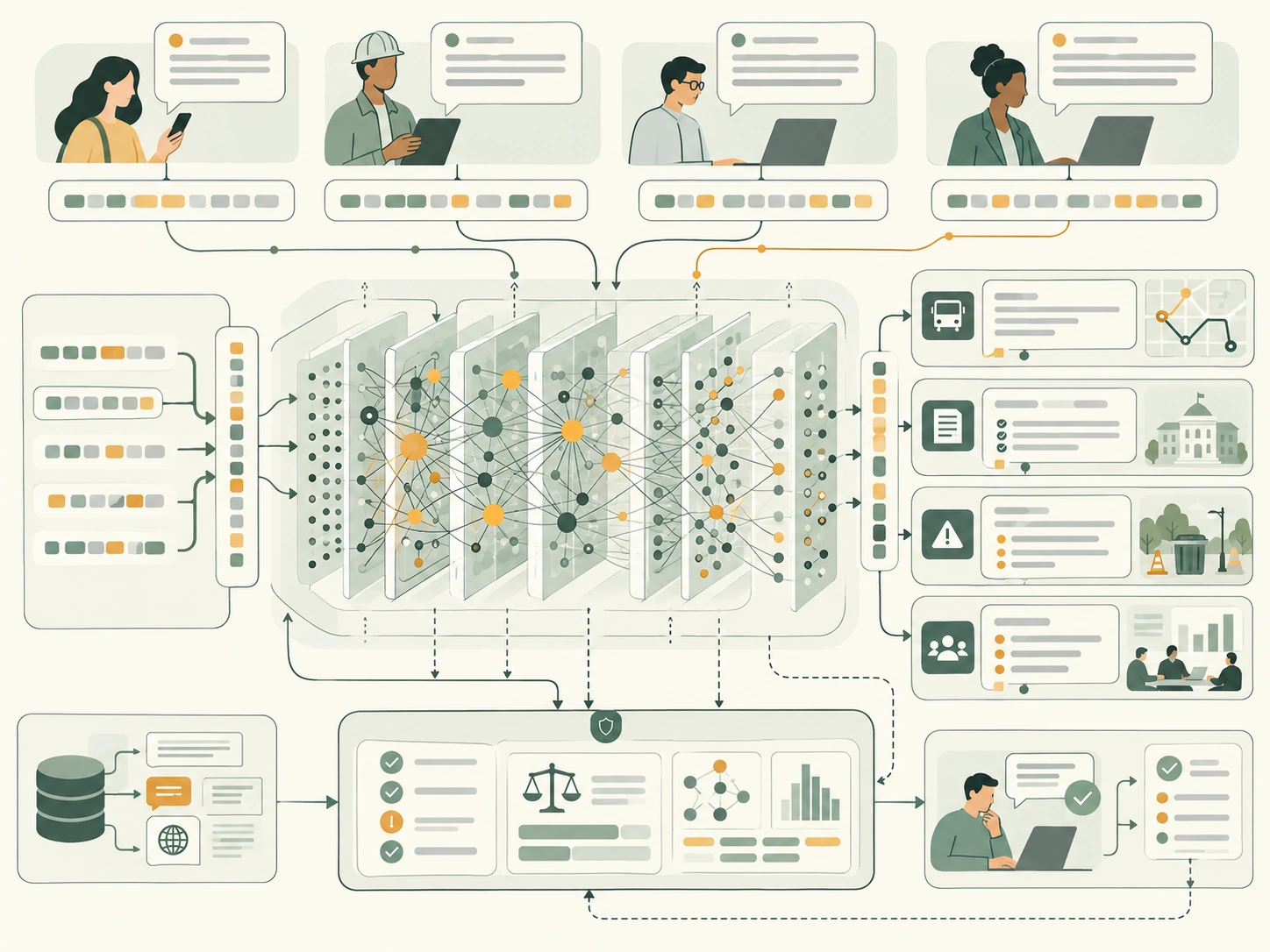
How it works
- 01Provide a prompt and, where appropriate, relevant context or tools.
- 02The model generates likely text based on learned patterns and its input context.
- 03A user or application checks the output against authoritative records and task rules.
- 04Monitor failures, data exposure, model changes, and user reliance over time.
- 01
Provide a prompt and, where appropriate, relevant context or tools.
- 02
The model generates likely text based on learned patterns and its input context.
- 03
A user or application checks the output against authoritative records and task rules.
- 04
Monitor failures, data exposure, model changes, and user reliance over time.
Why it matters
LLMs can make interfaces to documents and services easier to use, but an unsupported answer about eligibility, safety, or deadlines can cause harm. Cities need to set clear boundaries and keep original sources accessible.
Typical Smart City applications
- Staff drafting assistance
- Plain-language explanations of published material
- Document discovery
- Internal knowledge interfaces with source links
Example data inputs
Strengths
- Can produce readable drafts and flexible language interfaces
- Can summarize or transform large text collections
- Can support users in asking questions naturally
Limitations and risks
- Outputs may be fabricated or confidently incorrect.
- Model knowledge can be stale and may not reflect local policy.
- Prompts and outputs can expose personal or confidential data if controls are weak.
Illustrative workflow
Applied city example
A city tests an internal assistant that drafts answers from current service manuals. Every answer links to source passages, staff approve external responses, and unsupported questions are routed to a human contact channel.
Related methods
- Natural language processing
- Retrieval-augmented generation
- AI agents
- Supervised learning
Frequently asked questions
Does an LLM know current city rules?
Only if current information is provided and checked. Model training alone should not be treated as an authoritative policy source.
Can an LLM answer residents without review?
Only for low-risk, carefully bounded tasks with monitoring and an accessible path to a person; high-impact advice needs stronger oversight.
Do citations guarantee a correct answer?
No. Citations must be checked to ensure they support the specific claim and are current.