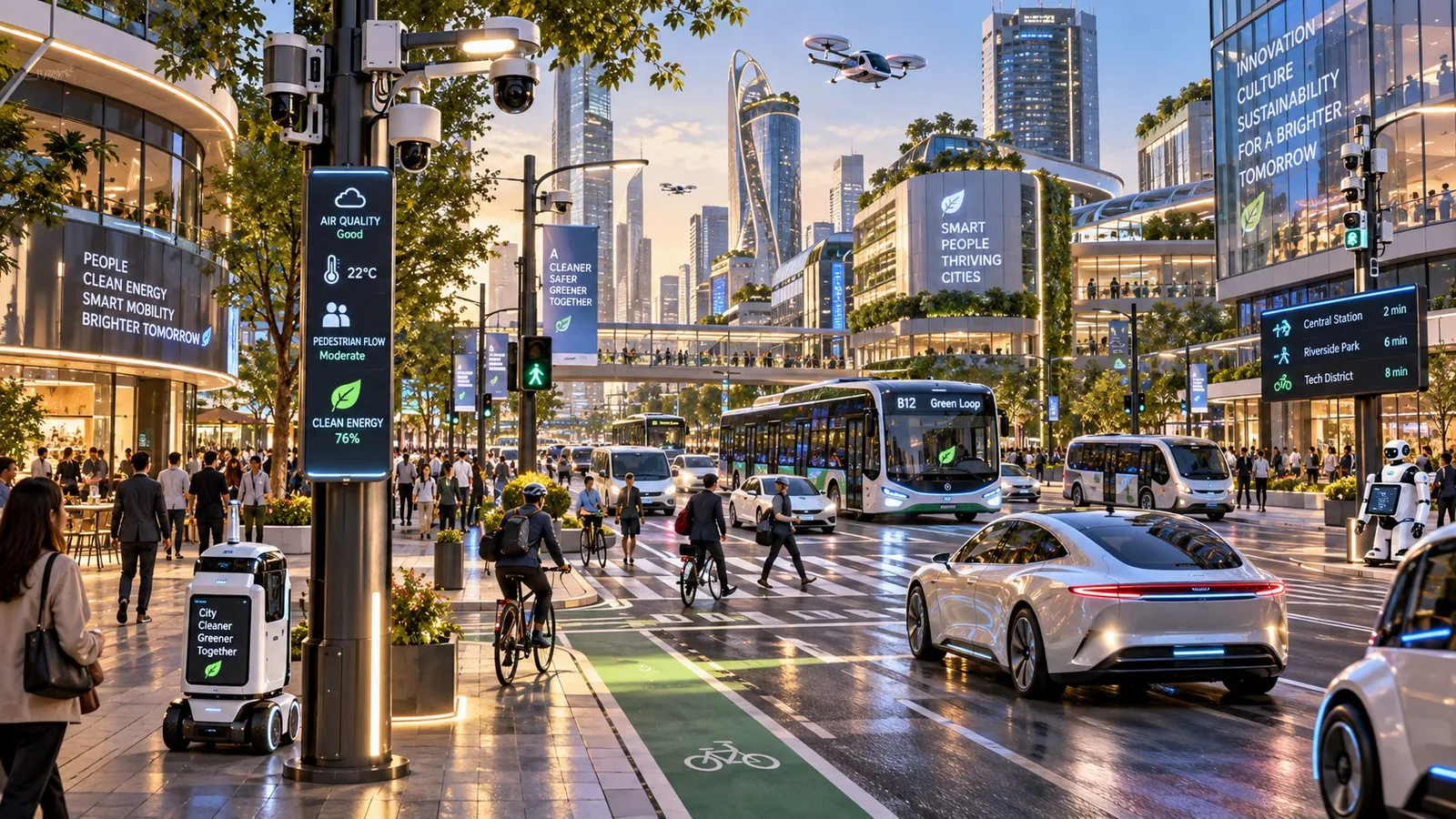
Artificial intelligence is usually discussed as software: a model, a service, or an application. In cities, its footprint is also made of substations, transmission lines, cooling systems, water connections, roads, and land. That physical layer is becoming a planning question in its own right.
The shift is visible in a new wave of city coordination. C40 reported in September 2026 that 49 cities representing more than 110 million people had endorsed its Global Urban Data Centres Pact. The pact calls for data centers to be strategically integrated into cities, to use resources efficiently, to engage local communities, and to contribute to lower costs and shared prosperity. The commitments do not settle every local siting dispute, but they signal that digital infrastructure is moving into the same conversations as energy, water, land use, and neighborhood impacts.
That is a useful correction to the idea that a “smart city” is mainly a collection of connected devices. Singapore’s GovTech describes IoT, AIoT, predictive analytics, and smart sensors as part of a responsive urban system, with the Open Digital Platform able to adjust district cooling and lighting in response to expected demand. Such applications depend on compute and communications infrastructure; they also depend on the physical systems those tools are meant to coordinate.
The policy challenge is to plan the whole chain. A city evaluating a data center or an AI-enabled service needs to ask where electricity and water come from, what capacity is reserved for future demand, how heat and noise affect nearby residents, and who receives the benefits. The same questions apply to connected transport, buildings, utilities, and public safety systems. Technical performance is only one measure of whether an urban system is working well.
For city leaders, the next step is not to label every server facility a civic asset or a burden. It is to connect digital-infrastructure decisions to transparent planning: publish assumptions, compare alternatives, involve affected communities early, and track resource use after projects open. That makes the “smart” in smart city less about the presence of technology and more about the quality of public decisions around it.