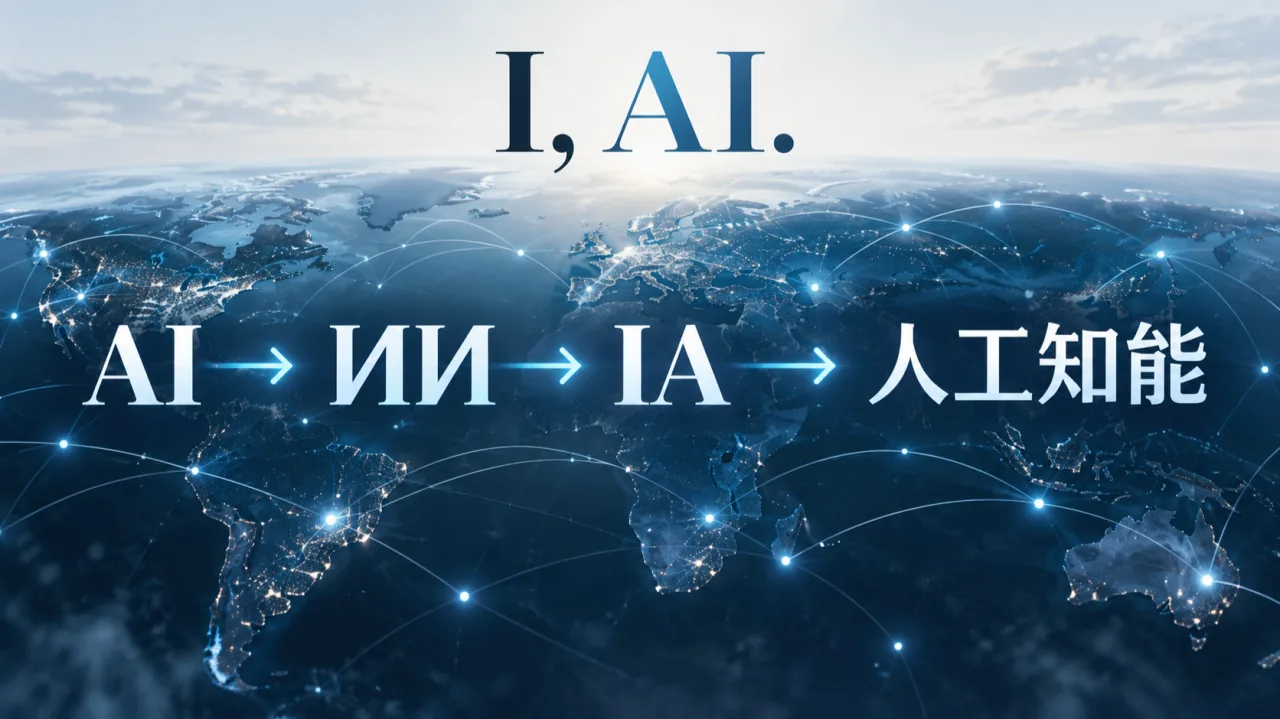
Some years ago, I called my book I, AI (https://tinyurl.com/3w5bdjaz)—an intentional homage to Isaac Asimov’s famous I, Robot.
At the time, there was certainly no question about what AI stood for.
The term “artificial intelligence” goes back more than 70 years. John McCarthy coined it in a 1955 proposal, together with Marvin Minsky, Nathaniel Rochester, and Claude Shannon, for what became the Dartmouth Summer Research Project on Artificial Intelligence in 1956. That gathering helped establish AI as a distinct field of research.
And now, apparently, AI has a new name—at least inside the U.S. executive branch.
On September 29, 2026, President Donald Trump signed an executive order directing federal executive departments and agencies to use “Super Intelligence” (SI) instead of “Artificial Intelligence” (AI) in official correspondence, public communications, websites, reports, policy documents, and other non-statutory materials.
There is an important distinction here.
This does not rename artificial intelligence everywhere. Universities, companies, researchers, Congress, other governments, and the rest of us remain free to call it AI. The executive order itself also says that previously issued regulations, contracts, grants, presidential actions, and historical documents do not need to be changed. For now, its definition of “Super Intelligence” covers the same technologies already included in the federal statutory definition of artificial intelligence.
There is also an interesting terminology problem.
“Superintelligence” already means something quite specific in the AI world: generally, a hypothetical intelligence that substantially exceeds human capabilities across a very broad range of domains. That is quite different from using “SI” as a new umbrella term for everything we currently call AI—from machine learning and computer vision to generative AI.
President Trump had introduced the new terminology a week earlier, during his September 22 address to the United Nations, declaring that AI would henceforth be officially called “Super Intelligence.” He also argued that “artificial” makes the technology sound fake and that “super” is a more accurate description.
Will it stick? That may be the most interesting part of this experiment in terminology.
“Artificial intelligence” is no longer simply an American term. It has equivalents deeply embedded in languages around the world:
Russian: искусственный интеллект (iskusstvennyy intellekt) — literally “artificial intelligence,” commonly abbreviated ИИ.
French: intelligence artificielle — literally “artificial intelligence,” abbreviated IA.
Japanese: 人工知能 (jinkō chinō) — literally “artificial intelligence” or “artificial intellect”; AI (エーアイ) is also widely used.
Over seven decades, AI has become part of the global scientific, technological, business, and cultural vocabulary. It is embedded in universities, companies, standards, products, regulations, films, books—and languages around the world.
It will be interesting to see how much one government's decision can actually change that. We might start talking about SI instead of AI, but where the technology goes next is the real story.