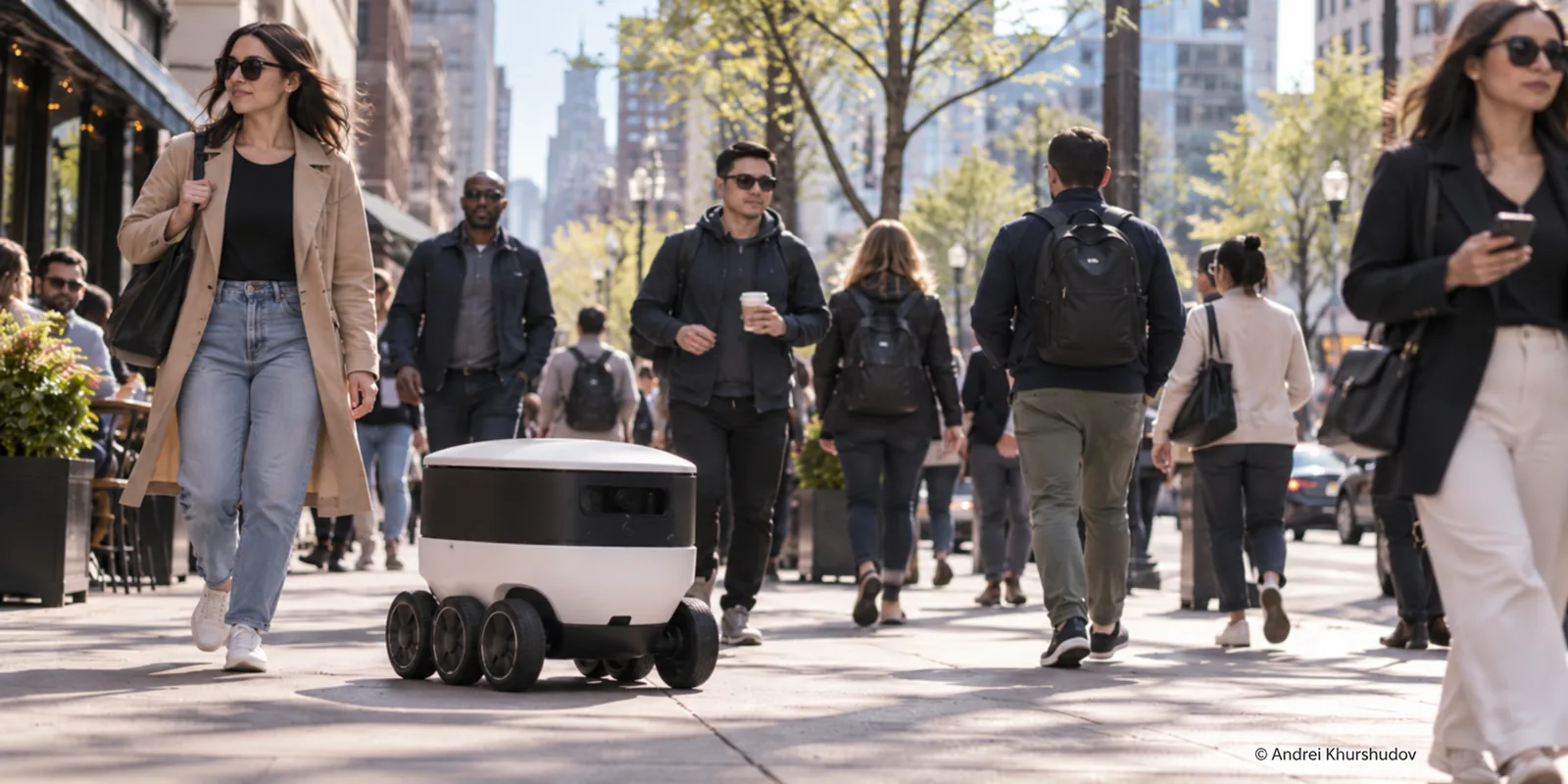
What happens when your sidewalk stops being just for people?
Autonomous delivery robots are already moving through cities around the world—and in some places, they are becoming surprisingly common.
China may be going furthest. Shenzhen already has hundreds of autonomous delivery vehicles moving parcels, groceries, and commercial goods, while Neolix alone has produced more than 10,000 vehicles. This is no longer just robotic food delivery—it is becoming autonomous urban logistics.
Russia offers a different example. Yandex operates more than 1,000 delivery robots across multiple cities, with Moscow one of the most visible deployments. They deliver food, groceries, and retail purchases, and some are now being used in hospital settings to move medicines, supplies, and biological samples.
Moscow also proves that these machines do not require perfect weather. They operate through cold, snow, rain, and darkness. The bigger problem is often the city itself: snowbanks, uncleared sidewalks, curbs, potholes, construction, and difficult crossings.
The United States is also scaling up. Los Angeles has hundreds of delivery robots from companies such as Serve Robotics and Coco Robotics, while Serve has been expanding into other U.S. cities.
And yet, I haven't seen one in the U.S. and—while I visit Tokyo every year—haven't seen one there either. That shows how unevenly this technology is spreading.
Scale changes everything. A few robots are cute; hundreds compete with pedestrians, wheelchairs, bicycles, and strollers for limited sidewalk space. Five robots are entertainment. Five hundred robots are infrastructure.
Theft appears to be less of a problem than expected: robots are tracked, locked, monitored, and difficult to steal. The bigger challenges are sidewalks, curbs, crossings, construction, accessibility, regulation, and occasional human intervention—like helping a drone out of the snow during a Moscow winter.
From a Smart City perspective, the question is no longer whether delivery robots work. They do. The question is what happens when there are thousands of them.
Cities may soon need to plan not only for pedestrians, bicycles, cars, buses, and trucks—but also for fleets of machines moving independently through sidewalks and streets.
When does a delivery robot stop being a gadget and become city infrastructure?