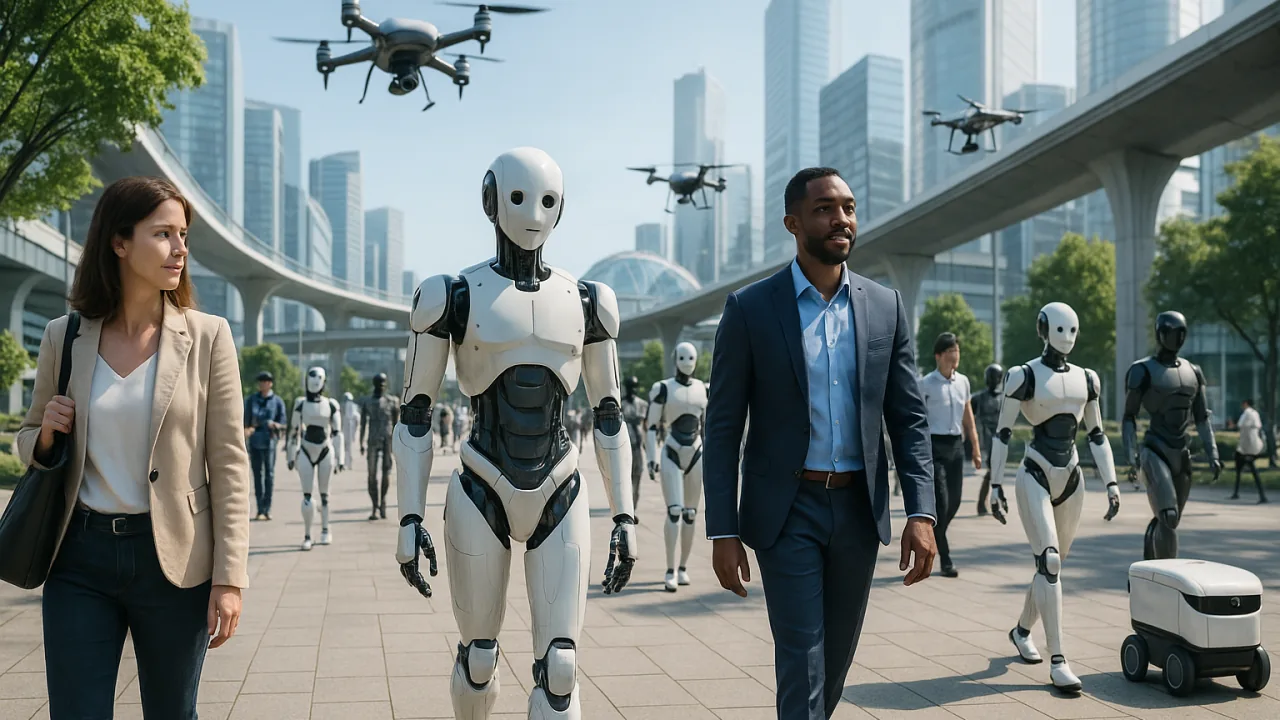
After several years of teaching Smart City Engineering with IoT at Yale, I’ve noticed a subtle but crucial shift in the narrative.
When the course began, students—and society at large—spoke of AI, autonomous vehicles, delivery drones, and robotics with anticipation. These technologies promised efficiency, automation, and optimization—a smarter way to improve quality of life, ecological balance, and economic competitiveness.
But just a few years later, the conversation has changed.
Now the questions sound different:
What happens to human jobs as AI replaces editors, translators, illustrators, and even software developers? What happens to privacy in cities blanketed with sensors and AI-powered surveillance? What does it mean to live in a society where most decisions are automated?
This shift in mindset is why I propose a new term: The Post-Smart Society.
From Smart to Post-Smart
For two decades, phrases like “smart city” or “smart society” have captured the vision of a world shaped by interconnected systems, AI, and real-time data. It was the era of becoming smart—deploying 5G, building digital twins, enabling predictive maintenance, and embedding sensors everywhere.
But what happens after we succeed? After every light pole, vehicle, and device becomes part of the network—and AI quietly optimizes every decision?
That’s when we cross into the post-smart phase: a stage where technology stops being the headline, and the human and societal response becomes the real story.
It’s the difference between:
“We’ll have self-driving taxis.” → “Self-driving taxis and trucks are replacing the last drivers.” “We’ll monitor critical areas of the city.” → “We know we’re being watched all the time.” “AI will help us be more productive.” → “AI now decides who gets hired—or laid off.”
Why This Definition Matters
Because understanding drives action.
In a smart society, technology solves problems: traffic, energy waste, safety, inefficiency. But in a post-smart society, the very technologies once seen as solutions create new challenges—ethical, social, legal, and psychological. The solution becomes the problem.
This requires a new focus:
Not just on deploying the latest systems, but on building rules, rights, industries, and safeguards to govern their impact. And we’re not doing enough, especially for transformative technologies like advanced AI.
The profit-driven race to advance AI without sufficient ethics or oversight is already exposing how fragile our social frameworks are. As I wrote in Inteland:
“AI research is as dangerous as research on nuclear or biological weapons. One major mistake could wipe us out.” We’re failing to build the institutional, legal, and cultural infrastructure to ensure these systems serve humanity—not merely those who control them. The focus remains on “outcompeting” others rather than protecting everyone.
Living in the Post-Smart Era
The central question shifts from “What can technology fix?” to “How do we coexist with powerful systems without losing autonomy or dignity?”
Consider how quickly the unimaginable becomes normal:
Today, it’s strange to see people wearing masks just to avoid surveillance—unless there’s a pandemic. In the post-smart society, there could be an entire industry of facial privacy wearables: breathable, stylish masks that block recognition algorithms. Or personal camera-jamming devices or even jammers that block your GPS location. Drone jammers to protect private airspace above your house or outside the windows of your apartment. A legal, encrypted alternative internet for those who want genuine privacy. A personal override module for your rented autonomous vehicle—to ensure your route isn’t silently altered. Your own AI guardian: a digital agent protecting your privacy, data rights, and physical autonomy in real time—watching over you 24/7. And, perhaps most ironically, subscription privacy kits sold by the same tech giants that helped dismantle privacy in the first place.
These are not dystopian fantasies.
They are logical responses to a hyper-connected, post-smart world—tools to reclaim human agency even if it means outsourcing that defense to another layer of AI.
In the end, we may find ourselves buying back our own digital freedom from the very systems that took it away.