Background and Further Context
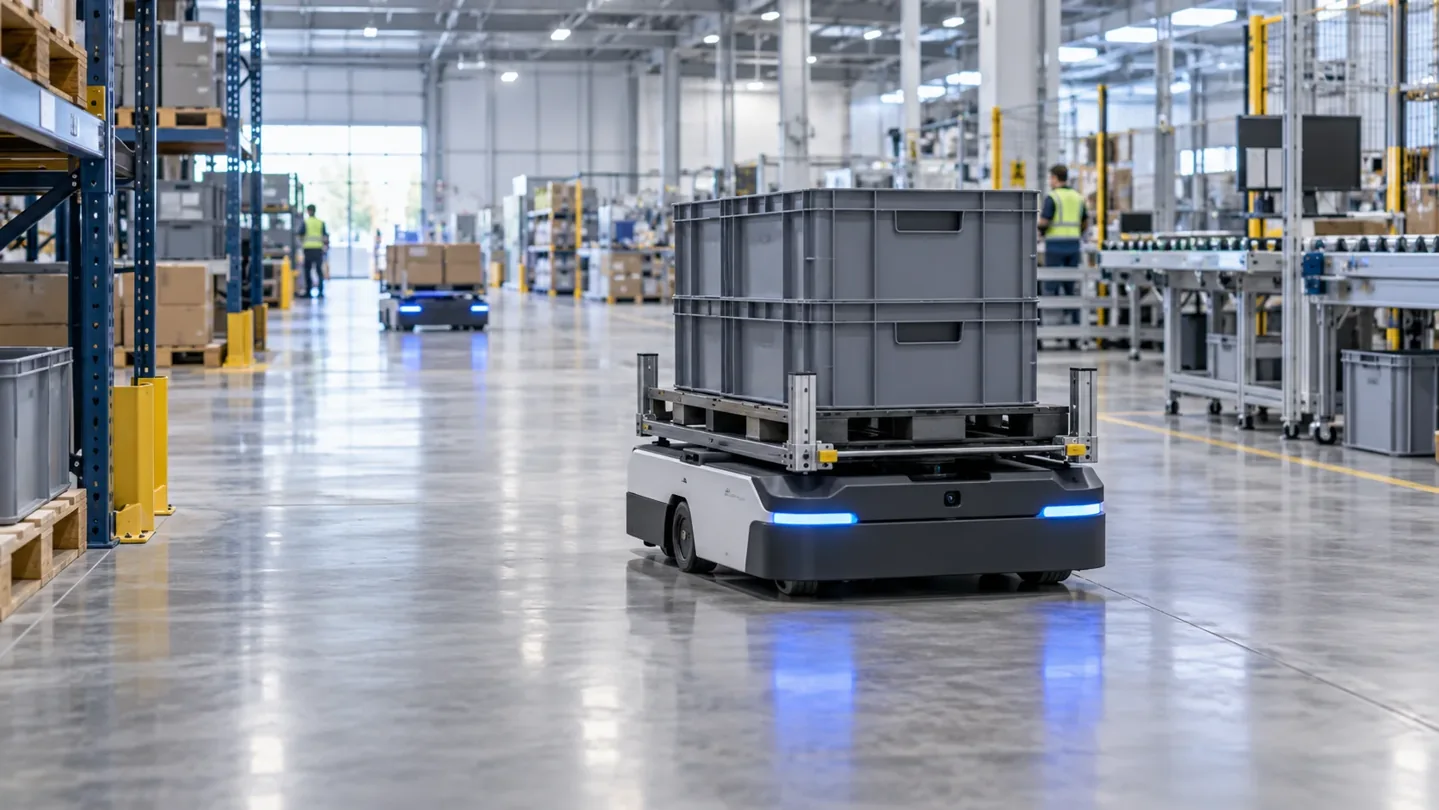
Automated material movement began with guided vehicles that followed wires, markings, or prescribed routes through factories. As sensors and computing improved, mobile robots gained the ability to map facilities, estimate their own position, and navigate around obstacles. The shift from fixed guidance to adaptive navigation made automation more attractive for facilities where shelves, workstations, and delivery needs change over time.
The robot's ability to navigate is only one part of the operating system. Fleet software assigns tasks and manages congestion, doors, elevators, charging, and handoffs with people or fixed equipment. Safety scanners, cameras, wheel encoders, and LiDAR may contribute to positioning and obstacle detection, but the choice depends on the application. Risk assessment is essential, including the relevant driverless-industrial-truck safety requirements and local site procedures.
Future robots may coordinate heterogeneous fleets more effectively and add mobile manipulation, such as placing equipment or using inspection tools. Their limitations will remain highly physical: moving people, unusual obstacles, floor conditions, elevators, access-controlled doors, and safe recovery when something goes wrong. For a public facility, success is a dependable and auditable service—timely supplies, fewer repetitive tasks, and safe shared spaces—not a demonstration of motion alone.
How the system fits together
Onboard navigation
Localization and obstacle sensors support route planning within a surveyed or learned operating environment.
Fleet orchestration
A controller assigns missions, charging, priorities, traffic zones, and exception handling across one or many robots.
Facility integration
Doors, lifts, carts, inventory records, work orders, and human supervision determine whether the robot actually improves a service.
- 01
Onboard navigation
- 02
Fleet orchestration
- 03
Facility integration
Where It Is Used
- Large hospitals, laboratories, and public campuses
- Transit depots and utility maintenance facilities
- Logistics and inventory in emergency-response facilities
- Construction-component factories and controlled jobsite support areas
Data generated
- Routes, mission completions, travel times, and interruptions
- Battery, charging, and equipment-health records
- Obstacle and near-miss events, where appropriate
- Task assignments and material handoff records
Analytics and AI applications
- Fleet scheduling and congestion reduction
- Navigation and obstacle classification
- Anomaly detection in missions, routes, and charging
- Demand forecasting for repetitive material movements
Example in practice
A municipal maintenance campus assigns indoor robots to move stocked parts between a storeroom and repair bays. Staff examine delivery times, manual interventions, and safety incidents to determine whether the system saves labor without delaying technicians. This is an illustrative workflow, not a claimed deployment.
What Are the Benefits and Limitations?
The applications above describe what a system may support. Actual benefits depend on the operating context and should be measured against a clear baseline.
Limits and risks
- Indoor AMR navigation does not prove safe operation on public streets.
- Crowds, blocked corridors, elevator failures, and unexpected items can interrupt missions.
- Integration with facility systems can cost more than the robot itself.
- Video, telemetry, and access records must be governed for privacy and cybersecurity.
Design considerations
Begin with a bounded route and clear exception procedures. Map accessibility requirements, shared pedestrian spaces, doors, elevators, wireless coverage, charging, maintenance, and cybersecurity. Keep a supervised fallback when the robot cannot complete a mission.
Sources & References
Related infrastructure machines and robotics
- Tunnel boring machines for urban infrastructure
- Bulldozers and intelligent earthmoving
- Motor graders and precision road construction
- Wheel loaders in urban infrastructure work
- Industrial robot arms and infrastructure fabrication
- Ultra-class mining haul trucks: moving the materials behind cities
- Electric rope shovels: supplying the materials of modern cities
- Hydraulic mining excavators and the urban materials supply chain
- Dragline excavators: the giant machines behind resource extraction