Background and Further Context
Early earthmoving relied on people, animals, and pulled grading implements. The combination of crawler tractors and powered blades transformed construction during the twentieth century, making it possible to move large volumes of material predictably across uneven ground. Modern bulldozers added more efficient hydraulic control, stronger drivetrains, and precise feedback about blade position and machine loading.
Remote control and supervised autonomous operation are advancing in controlled sites, especially where people would otherwise face unstable slopes, contaminated ground, or other hazards. But a dynamic urban construction site is difficult to automate completely. Workers move through the area, buried utilities may be poorly documented, and nearby residents are exposed to noise, dust, and heavy-vehicle movements. A machine's ability to follow a digital surface does not guarantee that the design, soil condition, or construction sequence is correct.
Future improvements will combine terrain models, cameras, location sensing, and construction-management records to reduce rework and document what was built. Electric and lower-emission equipment may also help where noise and air quality are important, although suitability varies with duty cycle, charging access, and machine size. Cities should evaluate productivity together with worker safety, fuel use, ground disturbance, and the effect of worksites on nearby neighborhoods.
How the system fits together
Traction and earthmoving
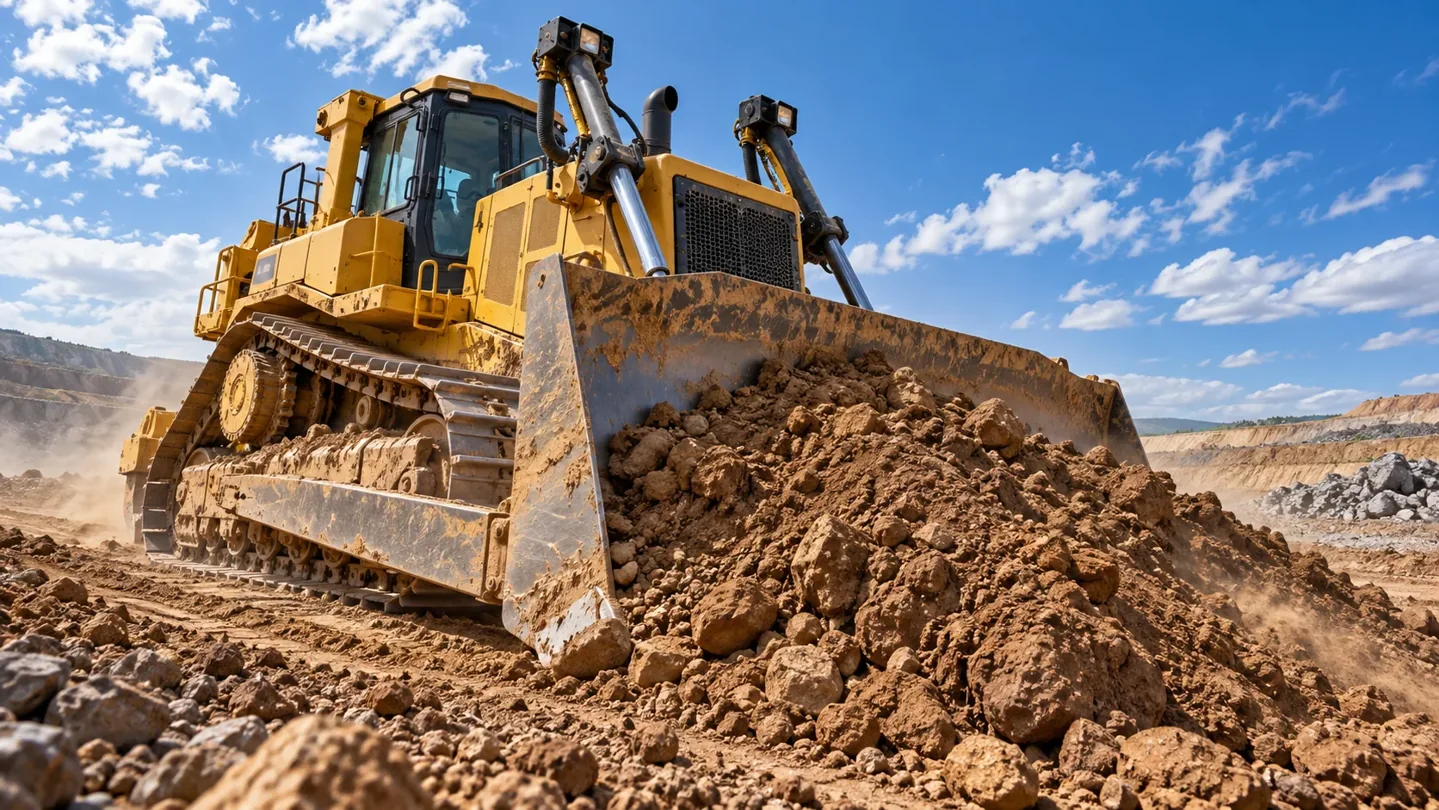
Tracks distribute machine weight. A front blade pushes, cuts, and spreads material; a rear ripper may loosen hard ground.
Grade guidance
Position sensors, design surfaces, GNSS where usable, and inertial instruments show the operator how the working surface compares with the plan.
Jobsite coordination
Survey crews, utility locators, site supervisors, and machine operators coordinate exclusion zones, earthworks quantities, drainage, and progress.
- 01
Traction and earthmoving
- 02
Grade guidance
- 03
Jobsite coordination
Where It Is Used
- Preparing sites for transit stations and public buildings
- Road embankments, roadbeds, and drainage earthworks
- Flood-protection berms and retention facilities
- Remediation and rehabilitation of disturbed sites
Data generated
- Machine position, blade height, and design-surface deviations
- Operating hours, fuel or energy use, and load measurements
- Cut-and-fill progress and material movement estimates
- Fault codes, maintenance events, and near-miss records
Analytics and AI applications
- Assisted grade control and progress mapping
- Detection of inefficient passes, excessive idling, and repeated rework
- Equipment condition monitoring and planned maintenance
- Supervised remote control in hazardous work zones
Example in practice
On an urban flood-protection project, dozers prepare an embankment using digital grade guidance. Survey teams regularly check the constructed elevation, while environmental crews monitor dust and drainage. The project team compares completed quantities and rework against the design. This is an illustrative workflow, not a claimed deployment.
What Are the Benefits and Limitations?
The applications above describe what a system may support. Actual benefits depend on the operating context and should be measured against a clear baseline.
Limits and risks
- GNSS and positioning can degrade near tall buildings or under structures.
- Underground utilities and changing ground conditions limit automation.
- Emissions, noise, and construction traffic can affect nearby residents.
- Precise machine control cannot compensate for bad design or inadequate geotechnical investigation.
Design considerations
Choose machine size, track configuration, and blade type for the site. Underground utilities, ground bearing capacity, construction traffic, dust controls, and safe separation from people matter as much as advanced automation.
Sources & References
Related infrastructure machines and robotics
- Tunnel boring machines for urban infrastructure
- Motor graders and precision road construction
- Wheel loaders in urban infrastructure work
- Autonomous mobile robots for urban facilities
- Industrial robot arms and infrastructure fabrication
- Ultra-class mining haul trucks: moving the materials behind cities
- Electric rope shovels: supplying the materials of modern cities
- Hydraulic mining excavators and the urban materials supply chain
- Dragline excavators: the giant machines behind resource extraction