Background and Further Context
Industrial robot arms emerged from the effort to automate hazardous, repetitive manufacturing tasks. Unimate, installed at a General Motors plant in 1961, is widely regarded as the first industrial robot used on a production line. Later generations added programmable motion, electric servo drives, improved sensing, and flexible tooling. Vision and force feedback helped robots work with more variation instead of repeating only one fixed path. <https://ifr.org/robot-history>
The robot itself does not solve the whole problem. Parts must arrive in predictable positions, fixtures must hold them safely, tooling must be maintained, and defects must be detected. Traditional cells operate behind guards or other safety systems. Collaborative configurations can work closer to people under specific engineered limits, but the word *collaborative* does not eliminate the need for application-level risk assessment. In many cases, a conventional dedicated machine is cheaper or more reliable than an advanced robot.
Future gains may come from easier programming, simulation, better vision-guided handling, and tools that learn a task from demonstrations. Fabrication robots could help address labor shortages and improve repeatability in modular construction, but variable site conditions, unstructured materials, and inspection requirements remain difficult. Cities ultimately benefit when manufacturing innovation produces durable assets, predictable construction schedules, better quality control, and safer work—not simply more robots in promotional videos.
How the system fits together
Manipulator and tooling
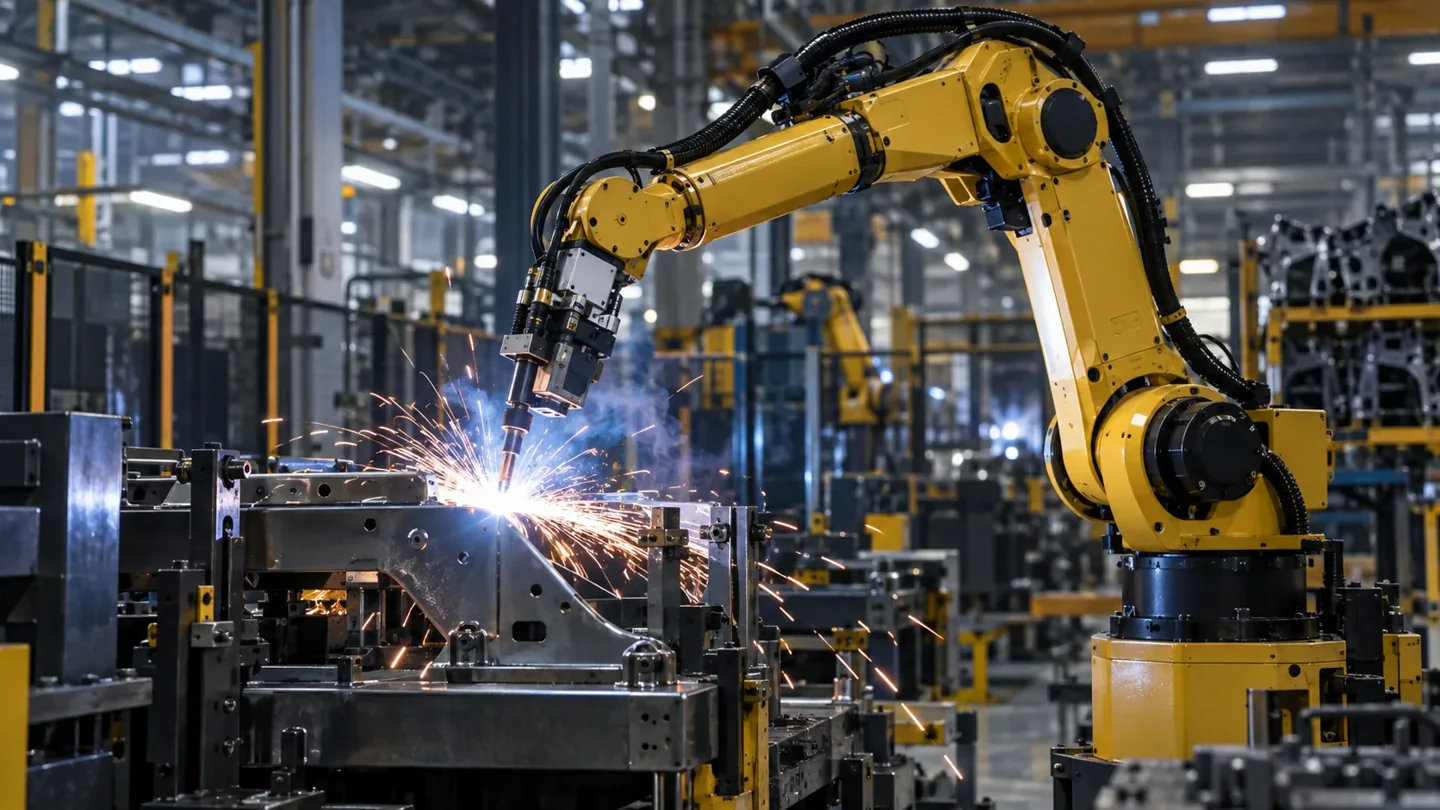
Powered joints position welding tools, grippers, cutters, cameras, or other end effectors within a specified reach and payload.
Programming and sensing
Motion programs, machine vision, force sensors, and control systems guide each operation and respond to known variation.
Work cell and quality control
Fixtures, guarding, conveyors, people, inspection procedures, and maintenance systems determine whether the whole process is productive and safe.
- 01
Manipulator and tooling
- 02
Programming and sensing
- 03
Work cell and quality control
Where It Is Used
- Manufacturing transit vehicles and replacement components
- Fabricating steel and modular construction assemblies
- Producing pumps, valves, electrical cabinets, and utility equipment
- Factory-based quality inspection of infrastructure components
Data generated
- Joint positions, cycle times, tool states, and fault histories
- Weld, cutting, assembly, or inspection measurements
- Equipment utilization and quality exceptions
- Maintenance and production traceability records
Analytics and AI applications
- Vision-guided part positioning and defect detection
- Robot-cell simulation and collision checks
- Predictive maintenance and tool-wear estimation
- Adaptive process control within validated operating limits
Example in practice
A factory producing modular bridge components uses robotic welding cells for repeated seams. Human inspectors examine the completed structures, and the fabricator retains production and inspection records for traceability. A city commissioning the bridge benefits from documented quality, not from a claim that the bridge was built autonomously. This is an illustrative workflow, not a claimed deployment.
What Are the Benefits and Limitations?
The applications above describe what a system may support. Actual benefits depend on the operating context and should be measured against a clear baseline.
Limits and risks
- Variable, heavy, or poorly positioned parts can undermine repeatability.
- Installation, tooling, and integration costs can dominate the arm's purchase price.
- Safety-rated controls and formal risk assessment remain essential.
- Factory success does not imply the same robot can work safely on an open urban jobsite.
Design considerations
Evaluate fixture design, part variation, safety guarding, access for maintenance, quality inspection, and required production volume. Before deployment, compare the robotic cell with simpler dedicated tooling and assess the whole process economics.
Sources & References
Related infrastructure machines and robotics
- Tunnel boring machines for urban infrastructure
- Bulldozers and intelligent earthmoving
- Motor graders and precision road construction
- Wheel loaders in urban infrastructure work
- Autonomous mobile robots for urban facilities
- Ultra-class mining haul trucks: moving the materials behind cities
- Electric rope shovels: supplying the materials of modern cities
- Hydraulic mining excavators and the urban materials supply chain
- Dragline excavators: the giant machines behind resource extraction