Background and Further Context
Tunneling began long before industrial machinery, using hand tools, explosives, and temporary supports to keep excavations open. Nineteenth-century shield-tunneling techniques helped crews work under rivers and through unstable ground. Mechanized boring became more practical with stronger cutters, better hydraulics, and improved surveying. The modern TBM combines excavation and ground-support tasks that previously demanded separate teams working in confined and hazardous conditions.
A TBM is sometimes described as an autonomous underground factory. In practice, modern systems automate selected functions—alignment guidance, pressure regulation, lubrication, segment handling, and performance monitoring—while trained operators and engineering teams remain responsible for changing ground conditions and emergencies. Sensors record torque, thrust, temperature, pressure, vibration, advance rates, and machine position. These measurements can warn of unusual conditions, but they cannot eliminate geological uncertainty or replace site investigation.
The next advances are likely to be incremental rather than fully autonomous tunneling beneath every city. Better interpretation of sensor data, predictive maintenance, digital project twins, and more coordinated logistics may reduce stoppages and help protect nearby buildings. Cost, underground obstructions, groundwater, surface settlement, cutter wear, and supply-chain interruptions will remain major constraints. The relevant question for cities is not how impressive a TBM looks, but whether a tunnel delivers needed capacity with acceptable risk, disruption, and long-term maintenance expense.
How the system fits together
Excavation and ground control
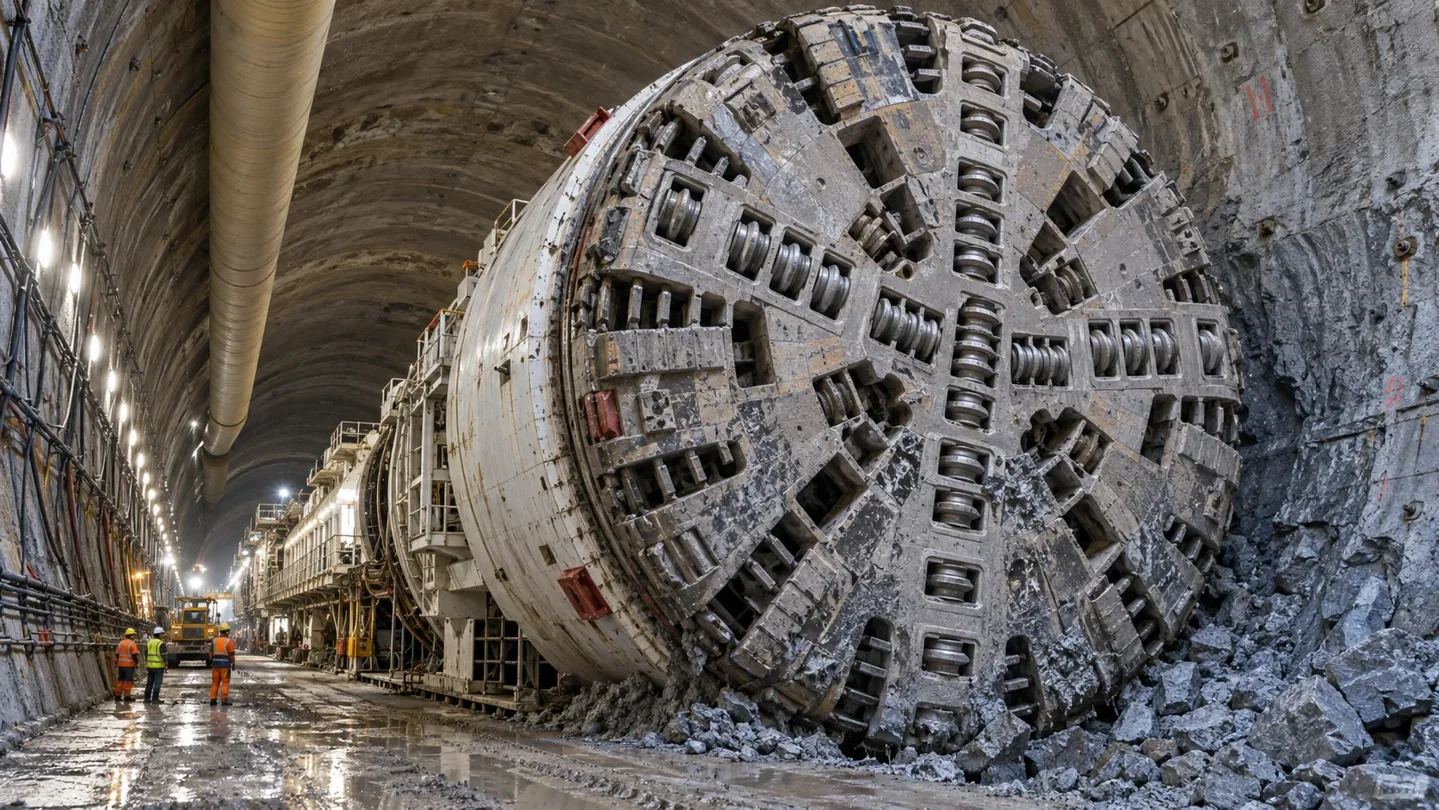
The cutterhead, thrust system, and face-support arrangement advance the tunnel while maintaining the stability required by local ground and groundwater conditions.
Spoil removal and lining
Conveyors, screw feeders, or slurry circuits carry excavated material away. Where required, segment erectors install rings that form the completed tunnel lining.
Guidance and operations
Survey instruments, position sensors, operators, and engineering models track alignment and equipment health. Above-ground teams coordinate material supply, spoil removal, safety, and settlement monitoring.
- 01
Excavation and ground control
- 02
Spoil removal and lining
- 03
Guidance and operations
Where It Is Used
- Subway, commuter rail, and highway tunnels
- Sewer interceptors and stormwater storage tunnels
- Water-supply and hydropower conveyance tunnels
- District utility corridors and underground crossings
Data generated
- Advance distance, cutterhead torque, thrust, and penetration rate
- Ground pressure, slurry parameters, and groundwater observations
- Alignment, settlement, and nearby-asset monitoring
- Cutter wear, downtime, maintenance, energy, and material logistics
Analytics and AI applications
- Detecting changes in excavation conditions from operating measurements
- Forecasting maintenance needs and interruption risk
- Optimizing advance rate against stability and tool wear
- Linking ground models, tunnel geometry, lining records, and work progress
Example in practice
A city constructing a new sewer tunnel compares pressure, torque, and advance data with the expected ground profile. If measurements depart from the predicted range, the tunneling team investigates and adjusts the operating plan. Instruments at the surface track any effect on nearby buildings. The digital record helps explain decisions but does not make safety judgments by itself. This is an illustrative workflow, not a claimed deployment.
What Are the Benefits and Limitations?
The applications above describe what a system may support. Actual benefits depend on the operating context and should be measured against a clear baseline.
Limits and risks
- Unknown ground conditions, buried obstructions, and water ingress can halt progress.
- Settlement or vibration can affect existing foundations and utilities.
- A high advance rate is not useful if spoil removal or segment supply cannot keep up.
- Automation remains bounded by safety requirements and specialist operator supervision.
Design considerations
TBM selection must be grounded in site investigation, groundwater conditions, logistics, emergency access, and the tolerances of nearby buildings. Procurement should consider both excavation and the long-lived tunnel asset. Machine telemetry needs stable units, calibration, and links to tunnel chainage and time.
Sources & References
Related infrastructure machines and robotics
- Bulldozers and intelligent earthmoving
- Motor graders and precision road construction
- Wheel loaders in urban infrastructure work
- Autonomous mobile robots for urban facilities
- Industrial robot arms and infrastructure fabrication
- Ultra-class mining haul trucks: moving the materials behind cities
- Electric rope shovels: supplying the materials of modern cities
- Hydraulic mining excavators and the urban materials supply chain
- Dragline excavators: the giant machines behind resource extraction